
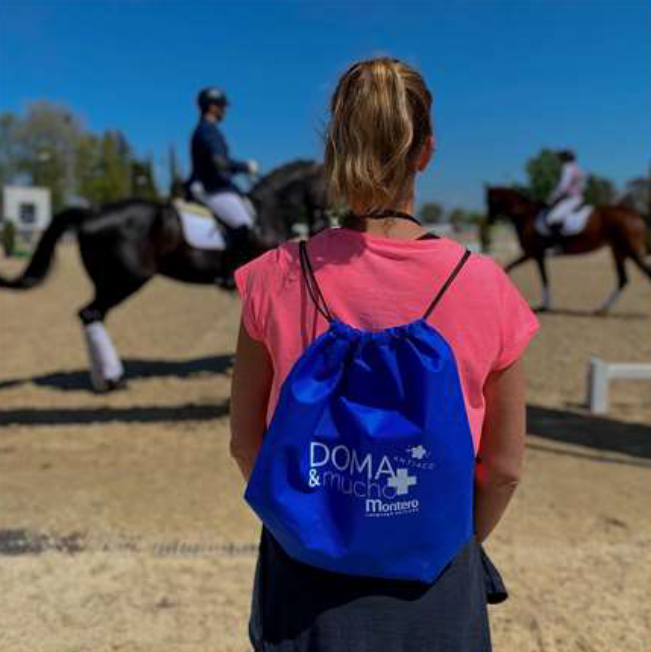
Summary of the results of the study Doma&Mucho+
Thursday 13 January 2022
Summary results of the Doma&Mucho+ study:
to determine the intensity of the competitive exercise of the dressage horse in Spain.

During the 2021 season, we monitored 38 horses aged 6 and over in 3 competitions, competing at different levels, from 6 year old level to Grand Prix, with both professional and amateur riders.
The results obtained up to now have confirmed the mainly aerobic nature of competitive dressage work, with an average heart rate of 103bpm in the warm-up and 127bpm in the reprise and an average post-exercise blood lactate concentration of 2.1 mmol/l.
A relationship can be observed between the difference between the average heart rate during warm-up and during competitive work and blood lactate levels after competition, such that the greater the difference between these heart rates, the higher the post-exercise lactate concentration, which confirms the key role of warm-up in the competitive performance of the dressage horse. Tyler, Hodgson, and Rose highlighted that in a muscle that is properly warmed up and therefore oxygenated, the aerobic metabolism will be the main source of energy. The observed results confirm that if the warm-up is carried out properly, lactate production is low, and therefore, the horse presents less muscular fatigue.On the other hand, lactate measurements at rest provided us with very interesting information about the state of the horse before the competition. The values observed at rest are somewhat elevated, which could be explained by several reasons:
- Accumulated muscle fatigue in the days before the competition
- Stress due to a change in environment and/or transportation
- Food not adequate for the level and/or discipline
Therefore, the results obtained confirmed our initial hypothesis about the eminently aerobic effort of the dressage horse during competition.
Regarding the measurement of lactate at rest, we found it doubly interesting because, on the one hand, it allowed us to observe its evolution during the competition and, on the other hand, it allowed us to obtain information about the mental condition with which the horse faces and experiences the competition.
With all this, overtraining could be detected and prevented.
Although stress levels in horses are measured by cortisol levels, a study published by Seifert and the Journal of Strength and Conditioning Research states that, in humans, in some sports, while heart rate is not a significant indicator of general fatigue, parameters related to cumulative stress as well as blood lactate levels can be used as field measurements in athletes prone to awareness of muscle fatigue, suggesting that lactate analysis is a practical marker for chronic stress assessment. Our hypothesis is that in horses in disciplines such as dressage, in which the average heart rate during exercise is less than 150bpm, the blood lactate levels at rest can allow us to determine the stress generated by the related situations created by the competition (transportation, routine changes, diet changes, overtraining, etc.).
The results obtained from the 38 horses tend to confirm the hypothesis, but it would be convenient to increase the sample size in order to draw valid conclusions.
On the other hand, highlighting the great impact of our study in competition thanks to the great reception by riders and trainers, since one of our objectives was to raise awareness among this group about the importance of monitoring performance based on data goals, it is crucial for us to spread the knowledge generated so the riders can apply it directly to optimize the horse's work, improve their mental condition, and ensure their well-being.
Lastly, highlight that the results obtained in the study during training corroborate the results observed in competition.
We hope to be able to monitor 25 more horses during the 2022 season to conclude the study.
